
For months, I blamed myself.
I told myself I lacked discipline. I told myself other founders simply wanted it more. I would sit at my desk at home, open a project, and watch the day dissolve into a hundred small things that were not the project.
Then, one Tuesday, something changed. And it had nothing to do with willpower.
I had slept properly for once. The next morning I packed my laptop, drove to a Starbucks, ordered an Americano, and sat down in a corner. I stayed for six to seven hours.
And I did more real work in that one day than I had in the whole week before it.
What actually happened
Here is the part that surprised me. Nothing about me was different. I was not more motivated. I did not find a new productivity app or a better morning routine. I had the same skills, the same worries, and the same to-do list.
What changed was the room.
At home, the day is full of tiny invitations. A phone call. A chore I notice out of the corner of my eye. A small request from someone who needs me for two minutes, which becomes twenty. None of these things are bad. Most of them matter. But together they chop a day into pieces too small to build anything in.
At the café, none of that could reach me. Nobody called. Nobody needed anything. I did not see the dishes, the laundry, or the leaking tap I keep meaning to fix. I could not see them, so I could not be pulled toward them.
I have always said I love working in silence, in a concentrated environment. I just never connected that preference to the way I actually structured my days.
The lie we tell ourselves
Most practice owners and business leaders I speak with believe their problem is time. Or energy. Or focus. They read another book on habits, buy another planner, and promise themselves that next week will be different.
But look closely at your own best days. I would bet they were not days when you suddenly became a more disciplined person. They were days when something removed the interruptions. A closed door. A flight with no wifi. A Sunday when the office was empty.
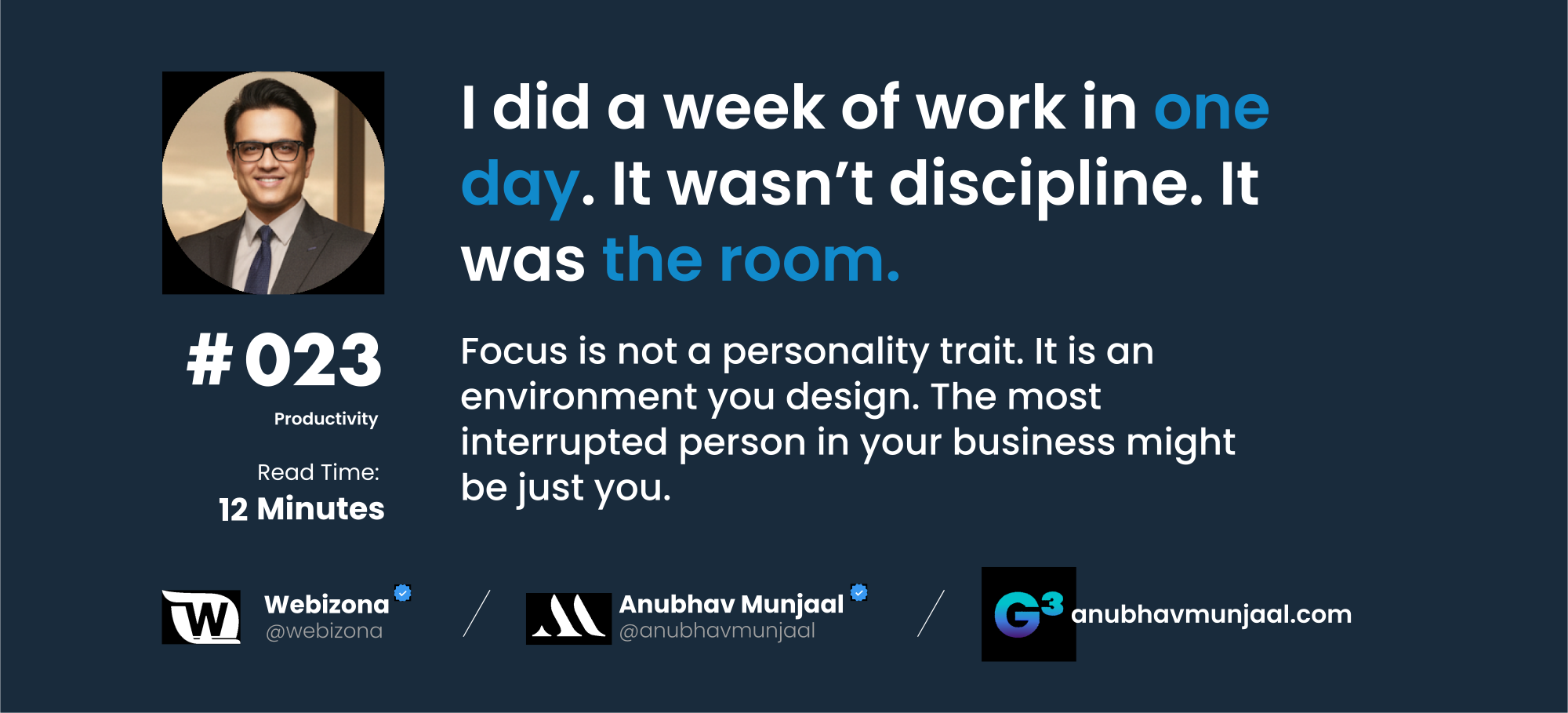
Focus is not a personality trait. It is an environment you design.
That sounds obvious when you say it out loud. Yet almost none of us design it. We leave our workday to chance, and then we judge ourselves for the results.
Why this matters more for owners
If you run a practice, a clinic, or a property business, you are the most interrupted person in the building. The front desk needs a decision. A client needs a call back. A team member has a quick question. Your inbox has opinions about your day before you do.
And the work that truly grows your business, the strategy, the offer, the follow-up system, the thing only you can do, is exactly the work that needs long, unbroken stretches. It gets squeezed out first.
So you stay busy all day and wonder why the needle has not moved.
The issue is not that you are working too little. It is that the right work never gets a quiet room to happen in.
The three things I now protect
After that day at the café, I stopped treating it as a lucky accident and started asking what made it work. Three things stood out.
First, a quiet place where nobody can reach me. Not a place that is nice. A place that is protected. The Americano and the corner table are lovely, but they are not the point. The point is that no one can walk in with a request.
Second, a fixed start and a fixed end. I knew I had roughly six hours, and I knew when they would stop. A day with edges feels different from a day that bleeds into everything. The boundary made me use the time instead of drifting through it.
Third, one clear task before I sat down. I did not arrive wondering what to work on. I walked in knowing the one thing that would move revenue forward, and I did that thing first.
Quiet. Edges. One task. That is the whole recipe.
Try this week
I will not ask you to rebuild your life. I am asking for one two-hour block.
Pick one window this week. Choose one location where nobody can reach you. It could be a library, a café, a spare room with the door shut, or your car in a quiet lot. Turn off notifications. Write down the single task that matters most. Then do only that.
When it is over, notice how the day felt. Notice what you finished. I think you will be surprised, the way I was.
A smaller idea of success
There is a bigger lesson hiding here, and it is one I am still learning.
We spend so much energy comparing our pace to other people’s. We look at the loudest founders online and feel behind. We assume the answer is to push harder, to want more, to become someone new.
But often the answer is far smaller and far kinder. It is a better room. A cleaner start. A quieter hour.
You do not need to become a different person to do your best work. You need to stop asking your best work to happen in the middle of a crowd.
If you have a day this week when everything finally flows, do not just enjoy it. Ask yourself what was different, and then do your best to build it again.
Until next time,
Anubhav
P.S. Reply and tell me where your quietest, most productive hours happen. I read every response, and I may share a few in a future issue.